Editor’s note: Imran Khalid, a special commentator on current affairs for CGTN, is a freelance columnist on international affairs. The article reflects the author’s opinions and not necessarily the views of CGTN.
In a sign of continued engagement between Beijing and Washington, Chinese Vice Premier He Lifeng, China’s lead official for economic and trade affairs with the U.S., held a video call with U.S. Treasury Secretary Scott Bessent on February 21. The two leaders exchanged views on implementing the consensus reached by their respective heads of state and discussed key economic issues that define the complex bilateral relationship.
This latest conversation underscores the growing momentum in China-U.S. economic and trade dialogues. Both sides have repeatedly affirmed the importance of economic cooperation, despite persistent tensions on multiple fronts. Diplomatic engagements have taken place at various levels, ranging from trade and commerce to strategic affairs. Parallel to these economic discussions, a member of the Political Bureau of the Communist Party of China Central Committee and and Chinese Foreign Minister Wang Yi recently spoke with U.S. Secretary of State Marco Rubio at Washington’s request. These exchanges indicate a measured and cautious approach from both sides as they navigate a relationship now characterized by friction and strategic mistrust.
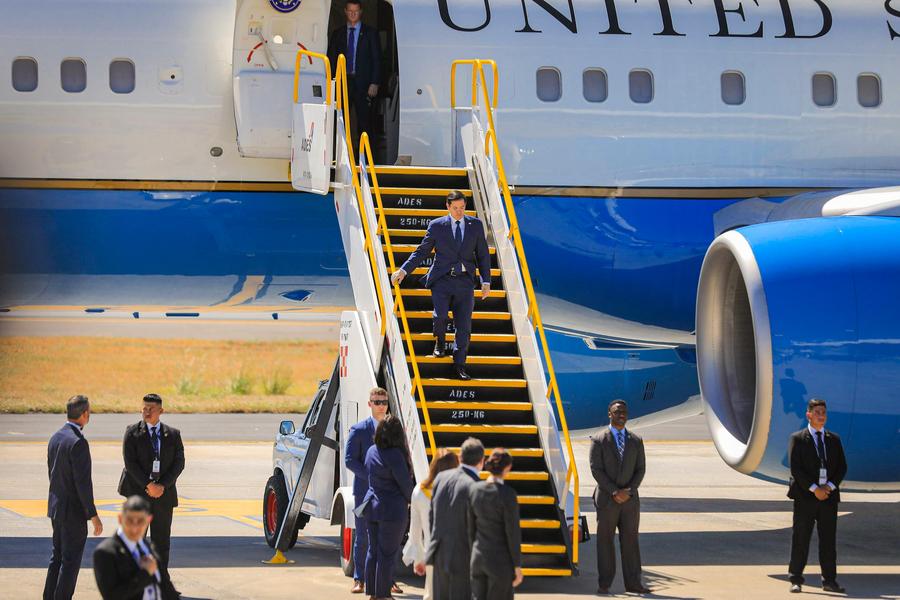
U.S. Secretary of State Marco Rubio arrives at the international airport in San Luis Talpa, El Salvador, Feb. 3, 2025. /Xinhua
However, while diplomatic overtures continue, Washington has simultaneously introduced measures that risk undermining progress. The U.S. State Department recently updated its fact sheet on China’s Taiwanregion, removing previous language that explicitly stated it does not support Taiwan’s independence. It also revised its China-related fact sheet to highlight economic concerns, emphasizing the U.S. trade deficit with China and alleged risks faced by American businesses operating in the country.
These policy adjustments have sparked concerns over a potential shift in Washington’s stance on the Taiwan question while exacerbating global trade anxieties. They reflect the deep ambivalence within the U.S. about how to engage with Beijing.
On one hand, the Trump administration, like its predecessors, continues to push a containment strategy, fueling narratives of competition and security threats. While there are demands for economic pragmatism and stability in China-U.S. trade relations, as reflected in the cautious rhetoric emanating from corporate America and certain factions within the U.S. government, this contradiction encapsulates America’s strategic dilemma: the desire to curb China’s influence while minimizing self-inflicted economic damage.
The inescapable truth is that trade wars are exercises in self-sabotage. For all of Washington’s posturing, the reality is that China’s massive consumer market remains indispensable to American businesses, just as U.S. technological innovation and management expertise continue to complement China’s economic evolution.


