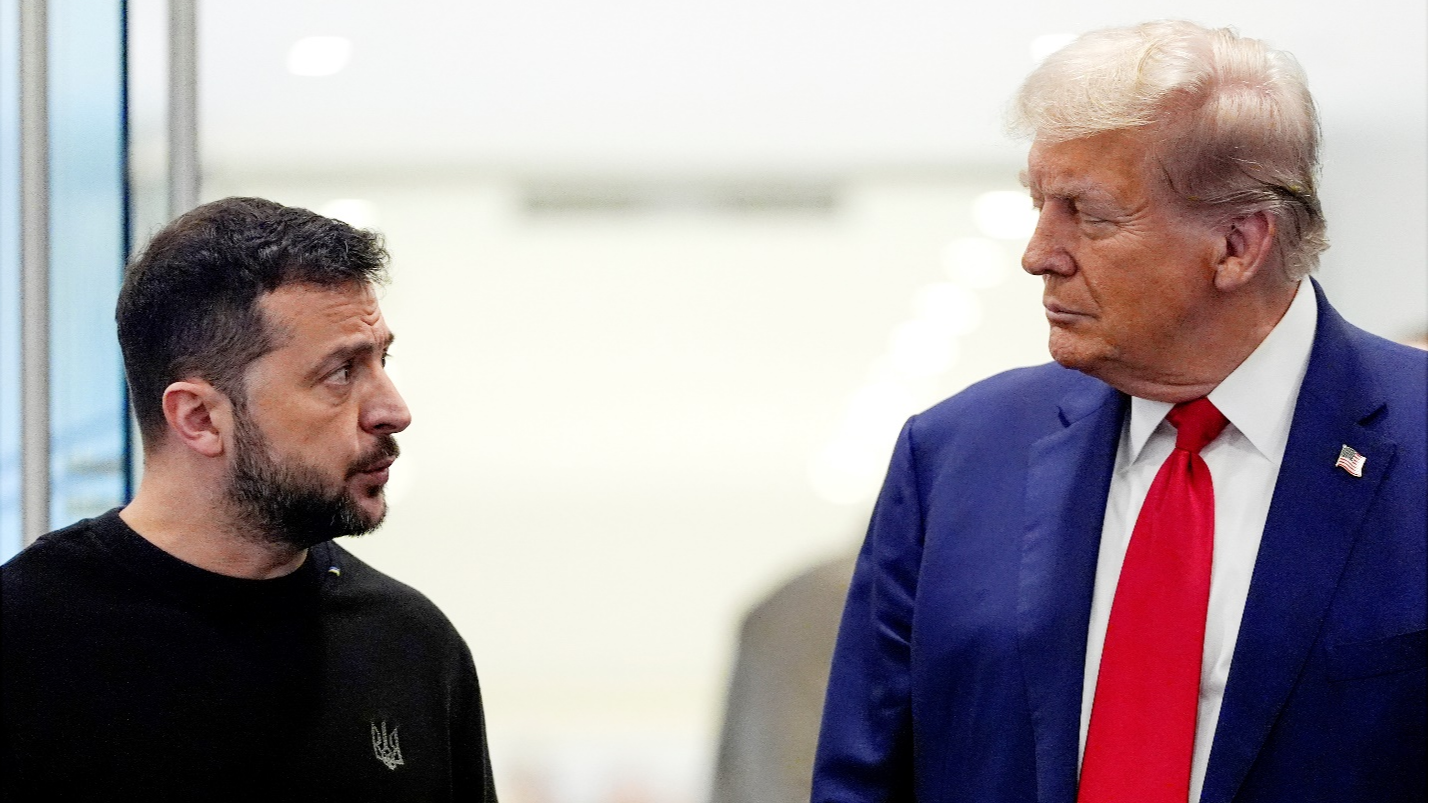
The then GOP candidate (and the current U.S. President) Donald Trump meets with Ukrainian President Volodymyr Zelenskyy in New York, the U.S., September 27, 2024. /AP
Editor’s note: William Jones, a special commentator on current affairs for CGTN, is a former Washington bureau chief for EIR News Service and a non-resident fellow of the Chongyang Institute for Financial Studies, Renmin University of China. The article reflects the author’s views and not necessarily those of CGTN.
U.S. President Donald Trump’s firm commitment to end the conflict in Ukraine, which he reiterated repeatedly during his presidential campaign, has been particularly unsettling to U.S. allies in Europe, as well as to many establishment figures in the U.S., many of whom wished to continue the conflict until Russia was “defeated.”
It is also clear that if the U.S. under a Trump administration abandons its war effort in Ukraine, it could not be continued even with continued support from Europe. But Trump was determined to end the conflict entirely and establish peace in the region.
The recent telephone call between Trump and Russian President Vladimir Putin and the subsequent meeting between top U.S. and Russian officials in Riyadh, Saudi Arabia, have set off something of a firestorm in European capitals.
French President Emmanuel Macron called a meeting of the EU nations in Paris on February 17 to discuss the matter, but no consensus was achieved, with many of the European leaders prepared to follow the U.S. lead in moving toward a negotiated solution of the conflict.


