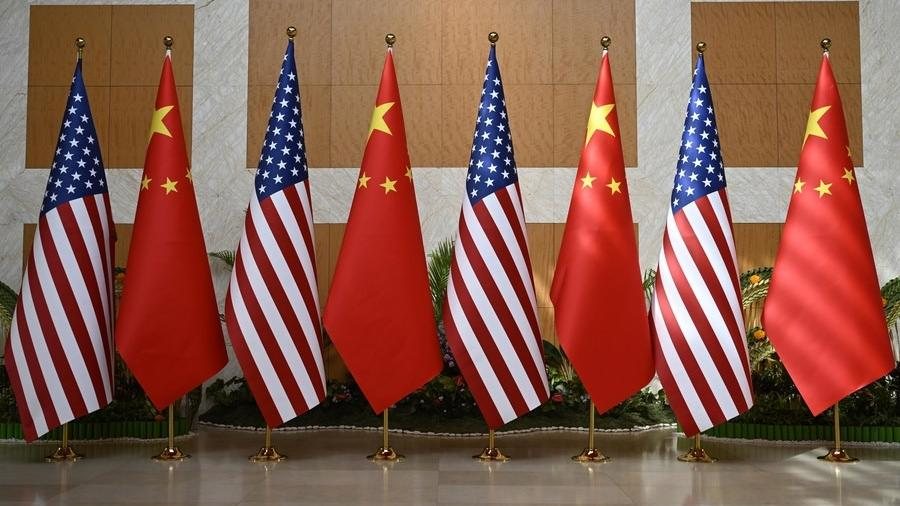
File photo shows the national flags of China and the United States. /Xinhua
Editor’s note: William Jones, a special commentator on current affairs for CGTN, is a former Washington bureau chief for EIR News Service and a non-resident fellow of the Chongyang Institute for Financial Studies, Renmin University of China. The article reflects the author’s views and not necessarily those of CGTN.
February 21 marks the 53rd anniversary of the visit of then U.S. President Richard Nixon to China in 1972. The visit changed the history of the world and provided a basis for the peaceful development of the Asia-Pacific region. While the spirit of the Cold War still reigned in the U.S., Nixon understood the importance of the populous People’s Republic of China in the future development of Asia and the world.
A conservative politician reared in the symbolism of the “Cold War” broke through the false shibboleths of that period to understand his responsibility before history. There are lessons here that could be learned by the incumbent American president.
The 25 percent tariff on steel and aluminum threatened by U.S. President Donald Trump, as well as the 10 percent additional tariff placed on Chinese goods, has sent something of a chill into U.S.-China relations. In addition, a number of well-known “China hawks” are now present in the Trump administration.
Nevertheless, many of the statements made by Trump with regard to his conviction that he will be able to “get along” with China and his continual praise of Chinese President Xi Jinping indicates that there may be another agenda behind the Trump policy than simply viewing China as a “rival.” In fact, rather than a “rival,” Trump may see China as a “competitor,” with whom he may compete, or with whom he may strike a deal.


