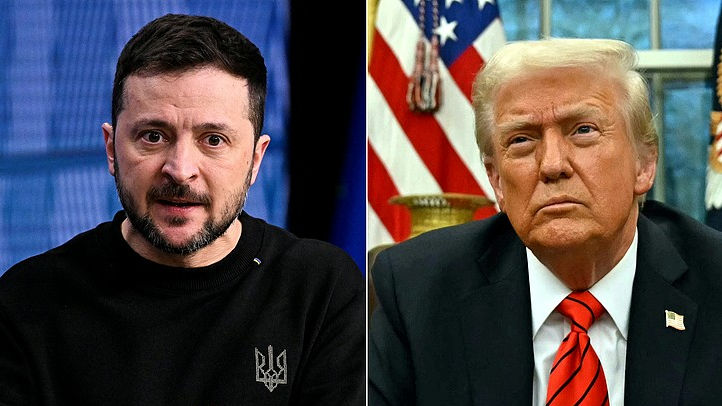
This combination of pictures shows Ukraine’s President Volodymyr Zelenskyy (L) and U.S. President Donald Trump (R). The U.S. President Donald Trump called Ukrainian leader Volodymyr Zelensky a “dictator without elections” on February 19, 2025, stepping up his attacks as tensions soar between Kyiv and Washington. /CFP
Editor’s note: Yasir Masood (PhD) is a Pakistani political and security analyst, broadcast journalist and strategic communication expert providing international relations insights for global media and think tanks. The article reflects the author’s opinions and not necessarily the views of CGTN.
Since taking office, Donald Trump’s foreign policy has deviated from traditional diplomatic norms, straining relationships with key allies, particularly in Europe. His “America First” doctrine prioritizes unilateral action and transactional deals over multilateral cooperation, weakening Western unity and raising doubts about the U.S.’s commitment to collective security and democratic values.
One of the most striking examples of this shift is Trump’s stance on Ukraine. While past administrations strongly backed Kyiv, Trump’s skepticism toward U.S. involvement has alarmed allies. His public denouncement of President Zelensky as a “dictator” and claim that Ukraine “started the war” starkly contrast with long-standing U.S. policy.
Beyond Ukraine, Trump’s overtures to Moscow and exclusion of European allies from key U.S.-Russia talks have heightened concerns about the reliability of American security commitments. European leaders, increasingly skeptical of U.S. leadership, are advocating for greater “strategic autonomy” and boosting defense spending. Trump’s repeated criticism of NATO and questioning of Article 5 have further strained transatlantic trust, fueling broader concerns about the weakening of Western unity.


