Editor’s note: The article, written by Peng Delei, a professor of the school of law at East China University of Science and Technology, reflects the author’s opinions and not necessarily the views of CGTN. It has been translated from Chinese and edited for brevity and clarity.
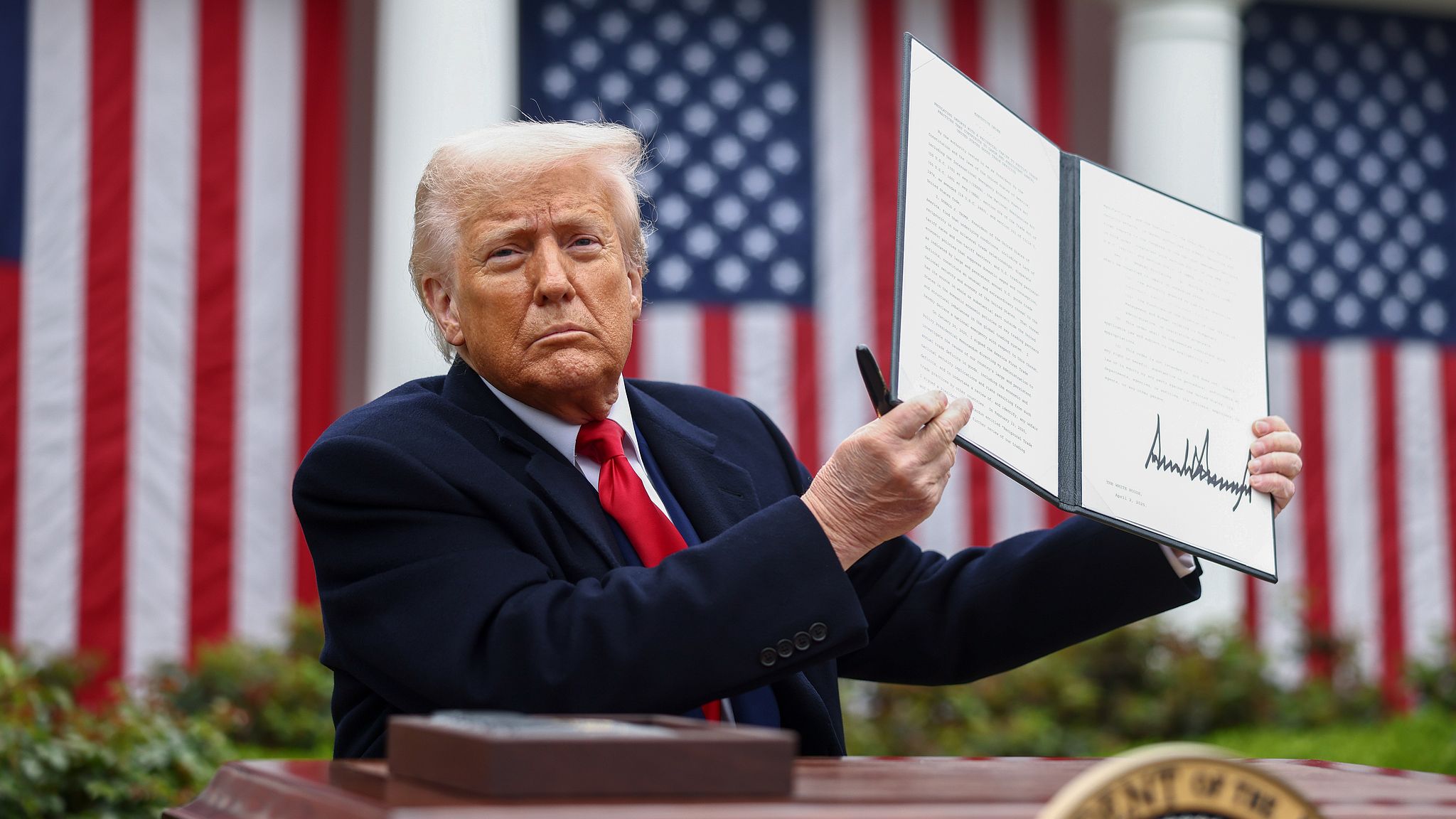
US President Donald Trump displays a signed executive order during a tariff announcement in the Rose Garden of the White House in Washington D.C., April 2, 2025. /VCG
Recently, the US government has introduced “reciprocal tariffs” in an attempt to rebalance global trade flows. However, this approach, capricious in execution and arbitrary in rationale, has undoubtedly antagonized its trade partners and is bound to provoke widespread backlash.
First and foremost, the US government’s push for “reciprocal tariffs” rests on a flawed premise. The “reciprocal tariffs” are intended to alleviate long-standing trade deficit pressures, bring manufacturing back to the US territory, and restore its competitive edge in global trade. However, this strategy lacks factual and legal basis. The US government has long been concerned about trade imbalances, which were once again emphasized at the recent World Economic Forum in Davos. It even went so far as to blame the Biden administration for exacerbating this problem. However, the assumption that trade deficits are primarily caused by tariff and non-tariff barriers and that such deficits alone warrant reciprocal tariffs is overly simplistic. Attempting to break down bilateral trade balances through reciprocal tariffs runs counter to the economic principle of comparative advantage. At the same time, it must be noted that the US’ long-term policies such as export controls on high-tech goods are themselves a major reason behind its persistent trade deficits with certain trade partners.


