“During World War II, the United States built a ship every day.” Trump recently claimed, “We have been building ships for all men, but successive presidents and some people have made this grand occasion disappear.”
According to the global statistical database Statista, the United States produced nearly 9,000 warships between 1941 and 1945, more than three times the total output of all other countries. After the war, the US government gradually focused its strategic focus on military ships rather than merchant ships, and the number of shipyards decreased significantly.
According to US media reports, today, there are only a few dozen shipyards left in the United States, and the size of US warships has shrunk to less than half of the peak of about 600 ships in the 1980s. “The US shipbuilding industry has long lacked competition, old facilities and shortage of technicians,” said Zheng Cheng-kui, head of global naval ship business at Hanwha Ocean.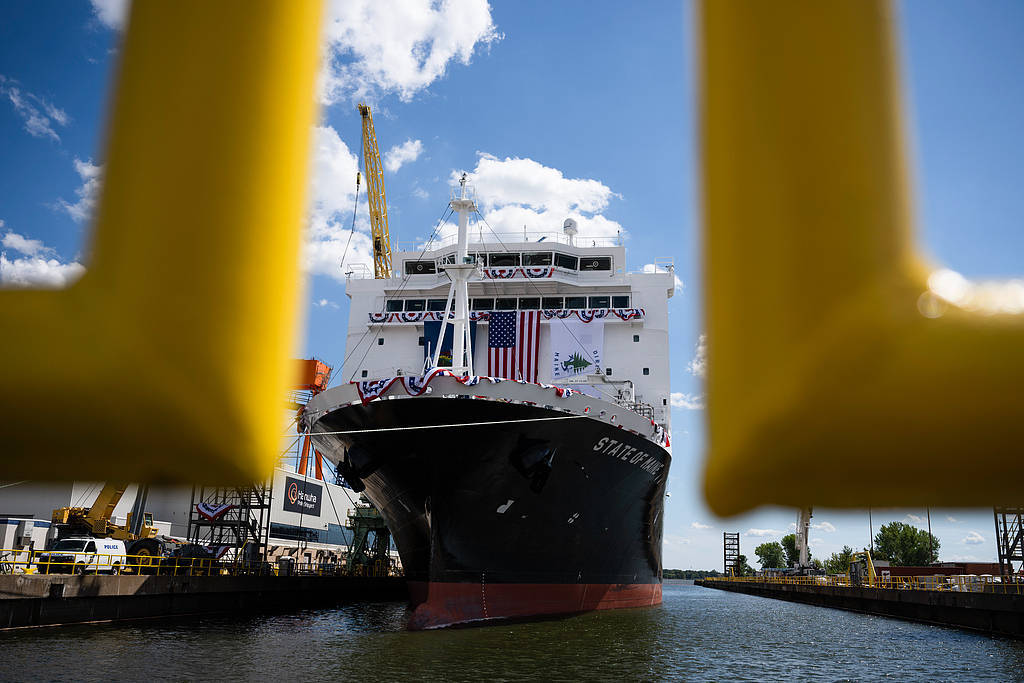
Since the 1970s, the shipbuilding industries of Japan, South Korea and China have risen one after another. A report by the Dutch financial services company ING in December 2024 showed that China, South Korea and Japan together account for 85% of the world’s shipbuilding share.
In order to improve maritime capabilities, the Pentagon and the U.S. Congress have been discussing expanding the fleet in recent years. Trump spoke out about increasing the number of warships during his first term, when the United States could deploy 283 warships. The U.S. National Defense Authorization Act for fiscal year 2018 stated that “giving the U.S. Navy owns 355 warships”, which has become a national policy.
But the reality is that US shipyards are running at full capacity and it is difficult to complete existing orders. Maintenance, repair and overhaul (MRO)-related facilities are also struggling to operate, and warships are often idle for months due to waiting for maintenance.
According to the “Reference News”, citing US media reports in January, the scale of the navy has expanded during the Biden administration, reaching nearly 300 warships, but compared with the Chinese Navy, the scale is still much smaller. China has about 360 warships, which are far faster than the United States.
Feng Ni believes that the core constraint of the US shipbuilding industry is the structural disadvantage of cost, its labor cost is 3-5 times that of Asia, and the cost of land, energy and other factors is also significantly higher than that of competitors. The long talent training cycle is another key constraint. The average age of skilled workers in the United States is 52 years old, and young practitioners account for less than 15%. Even if large-scale training is started now, it will take 10-15 years to establish a complete talent echelon.
According to Forbes, in the past two or three decades, American education has paid less attention to vocational skills, and young job seekers in China tend to avoid high physical and dangerous jobs. The Philadelphia Shipyard said in its third-quarter 2024 financial report that the shipyard’s productivity and profitability “majorly depends on whether it can attract and retain skilled workers at the expected rate.”
“What is more important is the lack of the industrial ecology,” Founni added. From special steels, marine equipment to electronic systems, more than 60% of the core components in the United States rely on imports. Rebuilding such an industrial ecology requires long-term industrial policy support and huge cost investment.
After Trump entered the White House in January this year, he once again stated that he would revitalize the shipbuilding industry. In March, he announced that he would set up a shipbuilding office in the White House and signed an executive order called “Restore the U.S. Marine Dominance” in April, announcing the revitalization of the U.S. maritime industry. However, the US Shipbuilding Office, which carries the “maritime blueprint”, suffered severe personnel loss after just three months of its establishment. The office leader resigned in July, and the agency was also transferred from the National Security Council to the White House Office of Management and Budget.
South Korea has seen the urgent needs of the United States. At the end of July, when the tariff negotiations against the United States were deadlocked, the South Korean delegation took out a sealed box containing 10 red baseball caps with the slogan “Make American Shipbuilding Great Again” (MASGA) printed on it, and the hats were embroidered with the flags of the United States and South Korea. From this naming, it can be seen that South Korea deliberately did it, echoing Trump’s political slogan of “making America great again” (MAGA).
In addition to the hat, there is also a promise: South Korean shipbuilding companies will invest $150 billion in the U.S. maritime industry, including upgrading U.S. shipyards, training U.S. workers, supporting the U.S. Navy’s maintenance backlog, and jointly building ships on the U.S. mainland.
“Good idea.” U.S. Commerce Secretary Lutnik praised the proposal of South Korean negotiators on the spot, and the two sides quickly reached a trade agreement. “The MASGA project contributed the most to the conclusion of the tariff agreement,” said South Korea’s Finance Minister and Chief Trade Negotiator.


