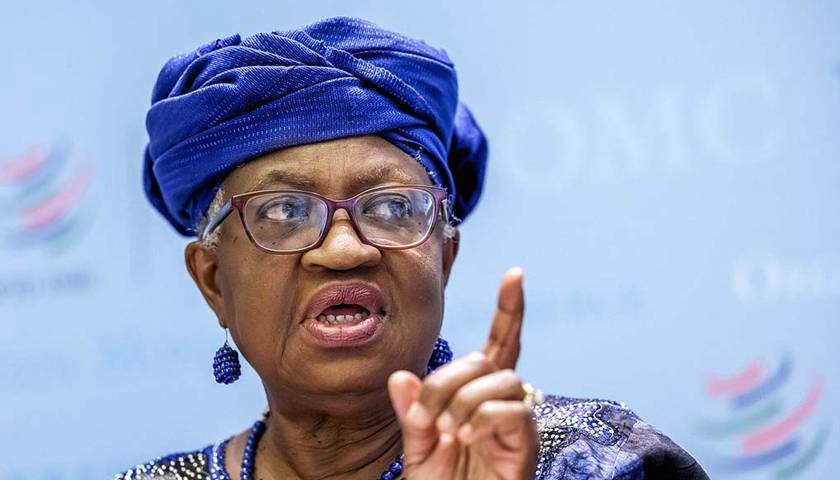
Ngozi Okonjo-Iveala, Director-General of the World Trade Organization (WTO), warned in an interview that tariffs are causing “unprecedented” damage to the international trade system in 80 years.
Okonjo-Iveala pointed out that the proportion of global trade under WTO clauses has dropped to 72%, and may decline further afterwards. WTO tracking shows that global trade under the WTO’s “most-favored-nation” treatment has decreased since US President Donald Trump imposed tariffs on U.S. trading partners. MFN treatment requires member states to treat all other member states equally in terms of trade preferences, privileges or immunities.
Okonjo-Iveala reminded that as companies from all countries rushed to stock up on a large scale before the tariff measures took effect at the beginning of this year, the impact of tariffs has not yet fully demonstrated. The impact of tariffs will be highlighted when inventory is exhausted in 2026. In its report released in August, the WTO predicted that global trade in goods will grow by 0.9% in 2025, higher than the contraction forecast in April, but lower than the 2.7% increase before tariff hikes. The WTO also lowered its global growth forecast for goods trade in 2026 to 1.8% from 2.5% forecast in April. The report warns that the high tariffs in the United States will drag down U.S. imports and curb U.S. trading partners’ exports in the second half of 2025 and 2026. Last month, Brazil filed a dispute consultation request to the WTO on U.S. tariff measures.
As the sixth largest trading partner of the United States, South Korea’s export growth rate has slowed sharply in August. Data released by the South Korean Ministry of Trade, Industry and Energy on September 1 showed that South Korea’s exports increased by 1.3% year-on-year to US$58.4 billion in August. Although it achieved positive year-on-year growth for three consecutive months, the increase in August was far lower than the 5.9% increase in July. Among South Korea’s 15 major export categories to the United States, 11 of them declined. Among them, steel fell by 32.1% year-on-year, becoming the area that was most severely impacted. The Bank of South Korea predicts that U.S. trade uncertainty will lead to a 0.13 percentage point decline in South Korea’s GDP growth this year.
The trade statistics results for July released by the Japanese Ministry of Finance at the end of August showed that due to the impact of US tariff policies, Japan’s overall exports in July showed the largest decline in more than four years, among which exports to the United States fell year-on-year for four consecutive months. Japan’s exports to the United States in July decreased by 10.1% year-on-year, of which the value of automobile exports fell by 28.4%.
The impact of Trump’s tariffs on the US economy is also emerging. On September 2 local time, data released by the American Institute of Supply Management (ISM) showed that the ISM manufacturing index in August was 48.7, slightly higher than 48 in July, but it is still below the 50-50-plus-bearing line, which means that economic activity is in a contraction. Data released by the U.S. Department of Labor last month showed that the U.S. producer price index (PPI) rose significantly in July, exceeding market expectations, which means that the upstream of the U.S. industrial chain is facing a new round of inflationary pressure. The U.S. PPI rose 0.9% month-on-month in July, significantly higher than the market’s expectations of 0.2%, the largest increase since June 2022; the index rose 3.3% year-on-year, the highest level since February this year.
The U.S. Congress Joint Economic Committee Minority Party (Democrats) issued a report warning that if economic uncertainty caused by Trump’s tariffs continues, U.S. manufacturing investment may drop by an average of 13% per year, and will shrink by about $490 billion by 2029. The report pointed out that since Trump announced so-called “reciprocal tariffs” in April, the U.S. manufacturing has lost 37,000 jobs, and manufacturing recruitment has fallen to its lowest level in nearly a decade.


