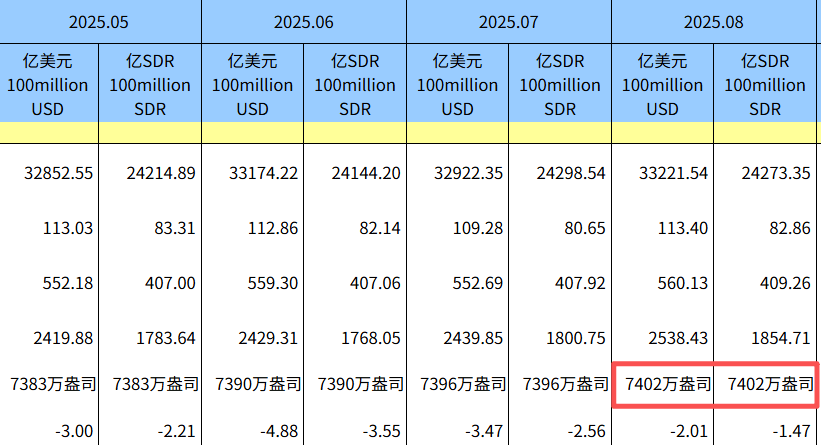
It is reported that global central banks are quietly adjusting their foreign exchange reserve structure, and the proportion of gold has increased significantly. As a typical case, China increased its holdings of gold again in August 2025, with a total reserve reaching a historical peak of 74.02 million ounces, an increase of 18% from 62.64 million ounces three years ago . Based on the current price of US$3,635 per ounce, the market value is nearly US$270 billion.
This trend is not unique to China. Data from the World Gold Council shows that global central banks have net purchases of more than 1,000 tons of gold for three consecutive years from 2022 to 2024. As of the latest statistics, the total gold reserves of global central banks reached 36,300 tons, with a market value of approximately US$4.65 trillion at current prices, exceeding the total global U.S. debt holdings except the Federal Reserve for the first time since 1996.
However, does this mean that countries will gradually sell off US Treasury and US dollar assets and turn to gold reserves in full? After rational analysis, we can see that there are obvious misunderstandings in this view.
The difference in statistical caliber needs to be clarified first: As the US central bank, the US $4.2 trillion of US bonds held by the Federal Reserve is not included in the foreign exchange reserves of various countries; while the global gold reserve statistics include 8,133 tons of gold held by the US government, which is close to the sum of the second to fourth largest holding countries.
If the U.S. holdings are excluded, central banks in various countries actually hold gold market value of about US$3.58 trillion, which is still lower than the scale of US debt holdings during the same period.

Specifically, looking at the changes in US bond holdings, the total amount of official US bonds in various countries was US$4.13 trillion at the end of January 2022, and fell to US$3.92 trillion by the end of June 2025, with a 5% decline, which needs to be analyzed in combination with price fluctuations.
As a market-oriented trading product, U.S. bonds have a market value directly affected by price fluctuations. In recent years, the rapid rise in US Treasury yields correspond to the continuous decline in prices. Even if the central bank does not actively reduce its holdings, the market value of holdings will “shrink” due to the price drop.


