“Starting next year, there is a high possibility that new energy vehicles will be subject to a 5% purchase tax. Because the relevant competent authorities issued a policy as early as 2023, clearly levied vehicle purchase tax on new energy vehicles with purchase dates between January 1, 2026 and December 31, 2027. ” On September 11, Cui Dongshu, Secretary-General of the China Passenger Union Branch, analyzed in an interview with a reporter from the “Daily Economic News”.
In June 2023, the “Announcement on Continuing and Optimizing the Reduction and Exemption Policy for Vehicle Purchase Tax” (hereinafter referred to as the “Announcement”) issued by the Ministry of Finance, the State Administration of Taxation, the Ministry of Industry and Information Technology and other departments clearly stated that new energy vehicles with purchase dates from January 1, 2024 to December 31, 2025 are exempt from vehicle purchase tax. Among them, the tax exemption amount for each new energy passenger car shall not exceed 30,000 yuan; vehicle purchase tax will be levied on new energy vehicles with purchase dates between January 1, 2026 and December 31, 2027 at half of the time. Among them, the tax reduction amount for each new energy passenger car shall not exceed 15,000 yuan.
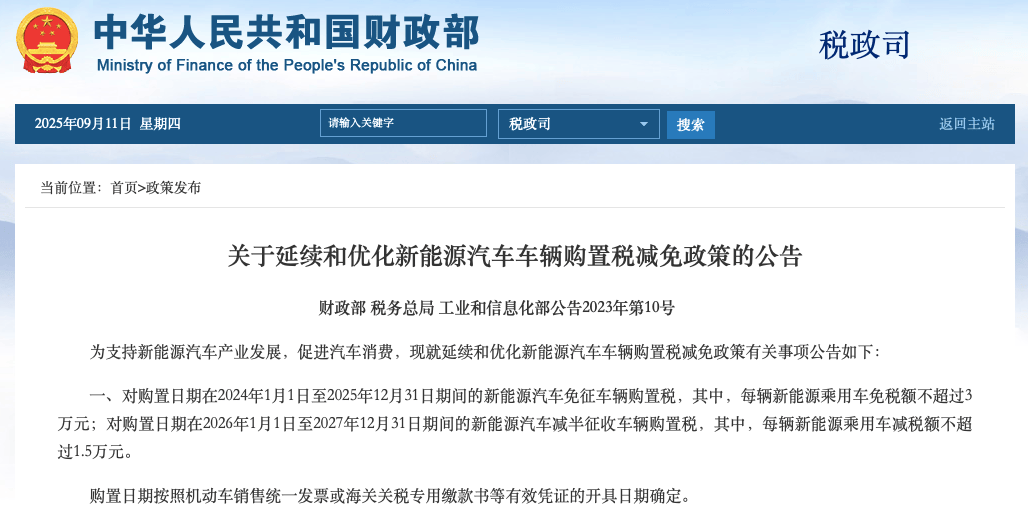
Image source: Ministry of Finance official website
In Cui Dongshu’s view, the adjustment of the policy on purchasing tax for new energy vehicles is not only an important measure for government authorities to gradually regulate competition in the new energy vehicle market, but also indicates that my country has completed the phased task of gradually developing new energy vehicles into a strong industry. “The end of the policy of exempting new energy vehicles from vehicle purchase tax is an inevitable trend for normal vehicle management on the policy side.” Cui Dongshu believes.
However, the relevant departments have not made clear statements on whether new energy vehicles will resume the collection of vehicle purchase tax from January 1, 2026.
New energy vehicles have become mainstream experts: there is great pressure to continue to be exempted from taxation
According to the requirements of the “Announcement”, from 2026 to 2027, individuals and units will resume levying vehicle purchase tax when purchasing new energy vehicles, but they can still continue tax incentives and enjoy half the levy. At present, the vehicle purchase tax rate in my country is 10%. Based on this calculation, the actual tax rate for new energy vehicles will remain at 5%.
Cui Dongshu analyzed that after years of development, my country’s new energy vehicles have developed to a relatively mature stage, and the sales of new energy vehicles have reached a relatively high level of 50% of the overall automobile sales, and the monthly market share of new energy passenger cars has exceeded half of the past few months. These all provide a basis for the adjustment of the new energy vehicle purchase tax policy.
The latest data released by the China Association of Automobile Manufacturers shows that from January to August 2025, my country’s total new energy vehicles sold a total of 9.62 million units, a year-on-year increase of 36.7%, and the sales of new energy vehicles reached 45.5% of the total sales of new automobiles. Among them, the domestic sales of new energy vehicles were 8.088 million, an increase of 30.1% year-on-year, accounting for 48% of the overall domestic sales of automobiles. “It is expected that this number will reach 50% in the whole year of 2025,” said Chen Shihua, deputy secretary-general of the China Association of Automobile Manufacturers.


