David Rosenberg, a well-known “big short seller” on Wall Street, is not always right. The founder of Rosenberg Research, who became famous for accurately predicting the 2008 recession , often expresses bearish views on the U.S. economy and financial markets —of course, these pessimistic predictions have often failed in recent years…
However, in a consensus environment where top Wall Street stock strategists are generally optimistic about the market, listening to Rosenberg’s warnings is obviously still the necessity of “listening to both sides”. Although his predictions usually don’t come true, it is undeniable that the well-known economist can always fully demonstrate his research basis and provide relevant data that deserves investors’ vigilance.
In a recent report to clients, Rosenberg provided a worrying set of historical statistics on the future return trend of the S&P 500 based on current valuations.
Rosenberg said the Schiller P/ E ratio of the S&P 500 is currently hovering around 37.5. According to his statistics, this has reached the third highest valuation level ever, second only to the turn of the century and peak levels in 2021/22.
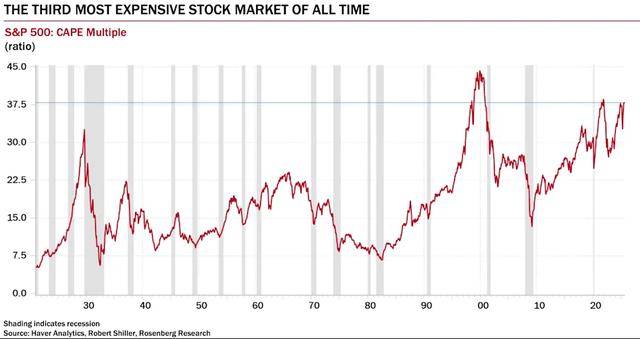
Schiller’s price-to-earnings ratio is the cyclical adjustment of the price-to-earnings ratio. This valuation indicator eliminates the interference of the economic cycle on short-term profits by calculating the ratio of stock prices to the inflation-adjusted average profits in the past 10 years, and provides a more stable valuation reference.
Although in the short term, valuation indicators have poor predictive power for U.S. performance. But Rosenberg’s data shows that when Schiller’s P/E ratio reached such an all-time high – despite only two previous cases – both U.S. stock returns will be negative in the coming year.
The following table shows the S&P 500’s return performance over the next 1, 3, 5 and 10 years when Schiller’s P/E ratio exceeds 35. “This is the only critical point where negative returns will occur for every period,” Rosenberg said in an interview.


