Recently, the International Monetary Fund (IMF) released its latest “World Economic Outlook” report, which pointed out that in the face of significant fluctuations in rules and policies, the global economy achieved a resilient and dynamic start in the first half of this year. However, as the supporting factors behind the resilience gradually faded, the global economy is currently showing signs of a moderate slowdown in growth, and this trend will remain long-term. In addition, the development prospects of industries such as artificial intelligence face greater uncertainty and may not be able to shoulder the important task of stimulating global economic growth.
The report pointed out that in the first half of this year, the global economy got off to a good start, with various economic activities around the world being active and strong, and inflation levels in the United States and Asian economies also being well controlled. The economic resilience in the first half of the year is more due to short-term factors. For example, economic activity entities have adopted measures such as preemptive imports, investment, and inventory management in response to the risks of U.S. tariff policies, which does not mean that the fundamentals of the global economy are strong. As the effect of the above-mentioned short-term factors fades, global economic data weakens significantly. The global job market is weak, and the impact of high tariffs on U.S. consumer prices is beginning to show. Developed economies that have always relied on immigration are experiencing a sharp decline in net labor inflows, which has a negative impact on their economic output.
The report predicts that the global economic growth rate will be 3.2% in 2025 and 3.1% in 2026. Based on year-end data, global economic growth will drop from 3.6% at the end of 2024 to 2.6% at the end of this year.
Although the impact of the U.S. tariff policy on the global economy in the first half of this year was less than initially expected, the increased policy uncertainty and the rise of protectionism are still the main factors leading to the slowdown in growth. The report predicts that the economic growth rate of developed economies will reach 1.6% in 2025. Among them, the U.S. economic growth will slow down to 2.0%; the growth rate of emerging markets and developing economies will reach 4.2%; the global inflation rate will drop to 4.2% in 2025, and will further drop to 3.7% in 2026. Among them, U.S. inflation will be higher than the target , inflation in other countries and regions will remain at a low level; global trade volume is expected to achieve an average growth rate of 2.9% in 2025, which is not only significantly lower than the 3.5% growth rate in 2024, but persistent trade fragmentation will further restrict trade income.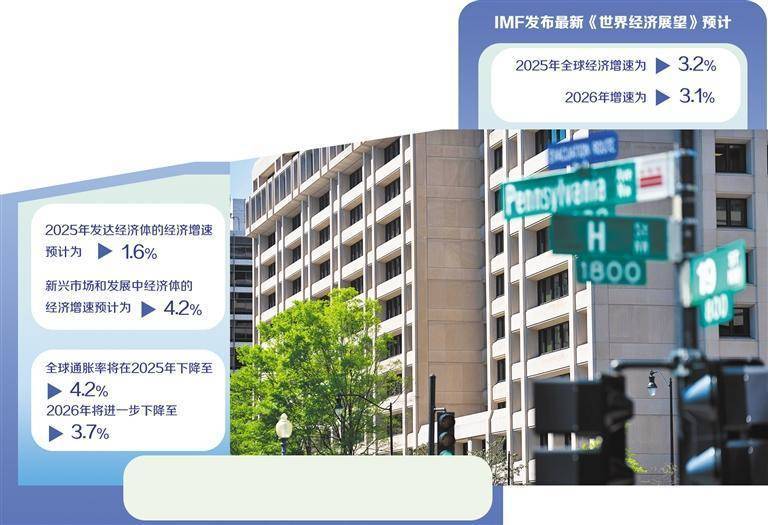
The report pointed out that the current downward risks facing the global economy continue to dominate. Long-standing policy uncertainty will inhibit consumption and investment; further escalation of trade protectionist measures, including the use of non-tariff barriers, will have negative effects such as suppressing investment, disrupting supply chains, and curbing productivity growth; the impact of restrictive immigration policies on labor supply will also weaken growth, especially for the population facing Aging and skill-short economies will have a greater impact; fiscal and financial market vulnerabilities will resonate with risks of rising borrowing and rollover costs; commodity price surges due to climate shocks or geopolitical tensions pose additional risks, especially for low-income commodity importers.
At the same time, the development of the artificial intelligence industry has risks of fluctuations in its role in driving the economy. If its earnings and production capacity perform poorly, it will trigger a sharp decline in the stock prices of technology stocks, thus ending the current artificial intelligence technology investment growth cycle and the financial market’s optimism about the industry’s prospects, and even having an impact on macro-financial stability. The report warned that the pressure exerted by the economic downturn risks on the independence of major economic institutions such as the central bank may weaken hard-won policy credibility and undermine sound economic decision-making, including due to reduced data reliability.
The report points out that policymakers should establish a clear, transparent and rules-based trade policy roadmap to reduce uncertainty, support investment and reap the productivity and growth dividends brought by more trade activities. Trade rules should be modernized and upgraded to adapt to the digital age and provide opportunities for strengthening multilateral cooperation. Trade diplomacy should be combined with macroeconomic adjustments, which is crucial to correct persistent external imbalances, address their root causes and ensure sustained gains.


