On the 20th local time, Australian Prime Minister Albanese, who was visiting the United States, met with US President Trump at the White House. During this period, the two sides formally signed the “U.S.-Australia Critical Minerals and Rare Earth Mining and Processing Supply Guarantee Framework Agreement.” According to the agreement announced by the two countries, the US and Australian governments will invest US$1 billion each in the next six months for the exploration, development, processing and production of key minerals.
Many Western media believe that the key minerals framework agreement reached by the United States and Australia this time is intended to target China. The Associated Press analysis said that if American companies can obtain some of the rare earth resources that Australian mines are already producing , the U.S.-Australia critical minerals agreement may have a direct impact on the supply of rare earths in the United States. But USA Rare Earth founder Pini Althouse warned Australia could not meet all of the US’s needs, so the US must continue to invest in long-term development, developing other mining and processing projects at home and in friendly countries. “Remember, China is nearly 40 years ahead of us,” Althouse said. “In terms of meeting our own supply chain needs, it will take at least several decades for us to catch up with China.”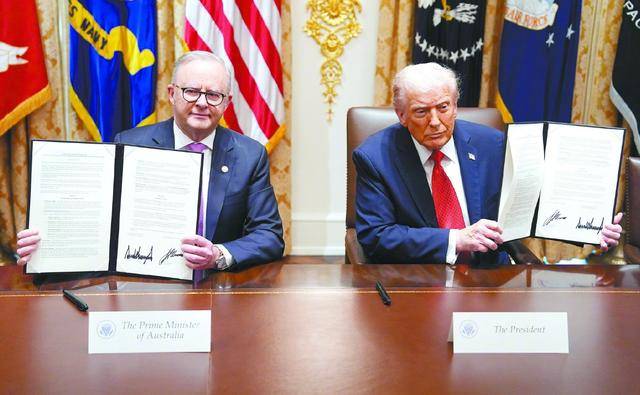
However, Australian Treasury Secretary Jim Chalmers told Bloomberg on the 21st that “China’s economy will continue to be an important source of our own economic growth” and “it is possible for us to engage with the United States as before, while continuing to stabilize and focus on developing the very important relationship with China.”
On the 21st, when answering questions related to the US-Australia critical minerals agreement, Chinese Foreign Ministry spokesperson Guo Jiakun said that the formation of the global supply chain is the result of market and enterprise choices. Countries with key mineral resources should play an active role in ensuring the safety and stability of industrial and supply chains and ensure normal economic and trade cooperation.


