in recent weeks, gold prices have climbed to unprecedented highs, and even die-hard gold investors have warned that this rapid rise has gradually gotten out of control. Now that gold prices have fallen sharply, they still firmly believe that gold’s long-term bull market is not over yet.
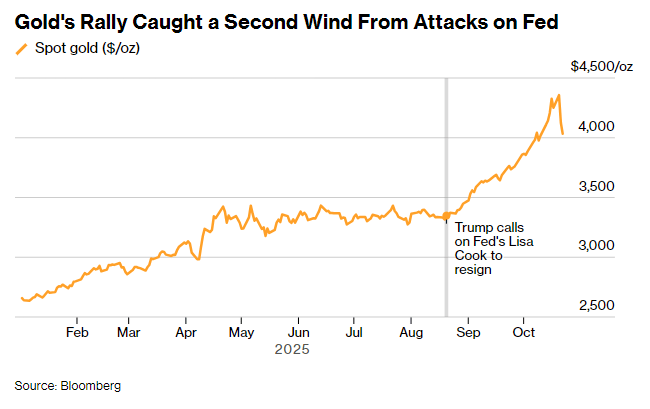
Kevin Smith, who manages US$420 million in hedge fund Crescat Capital, has been bullish since 2019 when gold prices were below US$1,500 per ounce. Although the price of gold has plummeted 6.5% in the past two days and is approaching the $4,000 mark, he still believes that now is the time to buy.
Concerns about expanding fiscal deficits are just the latest driver of this round of safe-haven demand for gold – gold prices have broken records before and have recently attracted bubble-chasing buying from retail speculators. Long-term investors like Smith view this week’s pullback as a healthy correction, noting that many of the core factors driving gold prices remain in place.
“There is no doubt that gold prices have risen a bit too much before,” he admitted in a phone interview. “But considering that the United States and most developed countries still have unsustainable debt and deficit imbalances, the current fundamental environment for gold is still very favorable.”
The wave of central bank gold purchases is the long-term driving force supporting this round of gains. The market generally believes that this pushed gold prices above US$3,500 last month, and it is widely expected in the industry that even if short-term investors withdraw, official purchasing power can effectively support the bottom.
“Those ‘weak chips’ – institutional funds and retail funds – have only been in the market for about six weeks. This round of gains is mainly driven by ‘strong chips,'” said Ross Norman, a veteran in the metals industry and head of the pricing and analysis website Metals Daily. “I think some of the ‘weak chips’ have definitely been washed out.”
Compiled data show that gold ETF holdings have increased by 4.2 million ounces in the past five weeks to nearly 100 million ounces, continuing a growth trend since the end of May. Since the financial crisis, major central banks around the world have been steadily increasing their gold reserves; after the United States and its allies froze Russian assets in 2022, the pace of central bank gold purchases doubled.
“After the Russia-Ukraine conflict broke out, we saw a significant change in the gold buying behavior of major central banks, and they have obviously become key long-term buyers in the market since then,” Andrew Matthews, head of precious metals distribution at UBS, said in an interview on Tuesday (before gold prices fell). “We think this will continue.”
This year, the Trump administration’s radical measures to reshape global trade and geopolitical uncertainty have added fuel to the rally. Expectations of interest rate cuts by the Federal Reserve have increased the attractiveness of gold relative to interest-earning assets, while Trump’s remarks threatening the independence of central banks have further strengthened its safe-haven properties.
The subsequent emergence of “sovereign credit devaluation trades” – that is, the selling of sovereign debt and its denominated currency due to concerns about the loss of currency purchasing power – has allowed retail investors to play a more important role in the recent market: gold ETFs favored by Western institutions and individuals have seen a surge in capital inflows, options trading volumes have increased simultaneously, and photos of long queues outside gold stores on social media have quickly gone viral.
“For many institutional investors, this is the straw that breaks the camel’s back,” said Jane Foley, head of foreign exchange strategy at Rabobank. “Obviously, I think it will be difficult for gold prices to return to recent highs in the short term.”
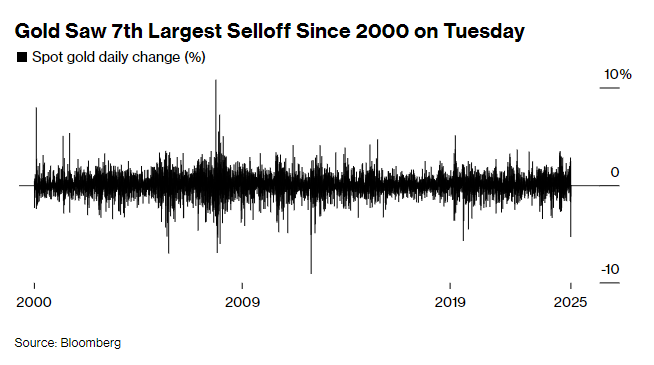
On Tuesday, a series of technical indicators showed that too much money poured in in too short a time, exacerbating the risk of a correction and bringing gold’s sharp rally to an abrupt halt. Spot gold plunged 6.3%, the largest decline since 2013.


