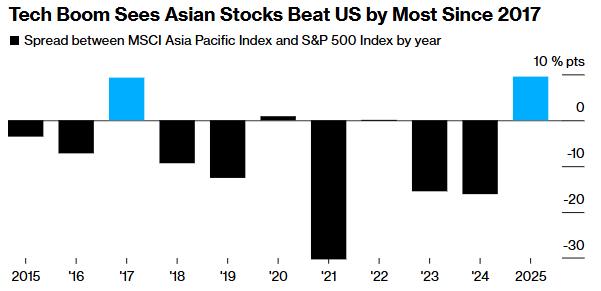
The market value of the six major technology stocks currently accounts for more than 30% of the S&P 500 Index. People are worried that if the market value of companies such as Nvidia (NVDA) soared from US$1 trillion to US$5 trillion in just two years, if this wave of gains quickly fell back, it would have a huge impact. At the same time, the artificial intelligence boom has helped Asian stock markets outperform the world so far this year; this craze is also changing Asian markets, and fund managers are racing to keep up.
The risks are more significant in some Asian markets, with Taiwan Semiconductor Manufacturing Company (TSM.US) alone accounting for nearly 45% of the Taiwan Weighted Index (Taiex), three times what it was a decade ago. The Korea Composite Stock Price Index (KOSPI) has formed a duopoly structure, with memory chip giants Samsung Electronics and SK Hynix accounting for a combined 30% weight.
The dominance of technology stocks in Asia’s benchmark indexes is upending traditional portfolio strategies. Index-tracking funds have had to increase allocations to technology stocks to keep pace, while funds that limit exposure to individual stocks have struggled to generate returns that match indexes dominated by a handful of chipmakers and internet companies.

Hebe Chen, an analyst at Vantage Markets, said: “The increase in fund concentration has blurred the line between passive and active trading, and fund flows are increasingly concentrated in a few stocks. With fewer channels for diversified investments, any stagnation in the momentum of artificial intelligence development may trigger a sharp adjustment across the region.”
The market value of Asian chipmakers has soared, with TSMC surpassing the $1 trillion mark in July. Investors have chased stocks that have benefited from huge investments in artificial intelligence in hyperscale data centers, pushing the MSCI Asia Pacific index up 26% this year, on track to post its biggest gain in eight years, surpassing the S&P 500.