The market value of Asian chip manufacturers can be said to have surged this year. Among them, TSMC’s market value exceeded the trillion-dollar mark in July. Investors are chasing companies that benefit from the wave of ultra-large enterprise AI spending, pushing the MSCI Asia Pacific Index up 26% so far this year, on track to post its largest gain in eight years and outperform the S&P 500 Index.
Recently, the latest financial reports of major companies in the AI supply chain in the Asia-Pacific region have obviously further fueled the market’s optimistic expectations for long-term demand trends. The continued surge in stock prices triggered by such good news suggests that market concentration may continue to snowball.
“The high and rising share of technology stocks in the index is a problem because investors (tracking) the benchmark index have to increase allocations to a very small number of concentrated stocks, which in turn drives up (tech stocks) share prices and weightings in the index, ” said Vey-Sern Ling, senior equity adviser for Asia technology at UBS Group AG. “This has created a negative cycle – constantly driving up the valuations of popular stocks.”
The problem is particularly acute for institutions entrusted with investing in specific markets. “The high concentration of benchmark indexes in a single region makes it more challenging to invest in funds with indexes in single regions such as South Korea and Taiwan,” an insider said sharply.
Even those markets that have not historically had a high proportion of technology stocks appear to be being affected. Japanese chip testing equipment manufacturer Advantest and SoftBank Group have now become the constituent stocks with the largest weight in the Nikkei 225 Index. Each of the two stocks accounts for more than 10%. According to the compilation rules of the Nikkei Index, an excessive weight of a single stock may trigger an adjustment mechanism, such as a forced reduction of its weight, which may cause the index fund to passively sell some stocks.
Earlier this year, the surge in the market value of the share price of Delta Electronics’ Thai subsidiary TEDA also triggered trading restrictions on the Stock Exchange of Thailand, which excluded TEDA’s shares from the credit limit.
According to the Stock Exchange of Thailand document, these restrictions are first-level market surveillance measures and will be implemented until October 30. The exclusion from the credit limit means that brokers cannot use TEDA stocks as guarantee when calculating credit limits for all types of accounts of customers.
At the same time, wider regional deals are becoming challenging. Citigroup data shows that the top five constituent stocks of the MSCI Asia Pacific (excluding Japan) index currently account for 29% of the total weight of the index, approaching the peak since 2019. Analysts Yue Hin Pong and others pointed out in a report this month that stocks such as Alibaba, Tencent Holdings and TSMC have the highest degree of bull congestion.
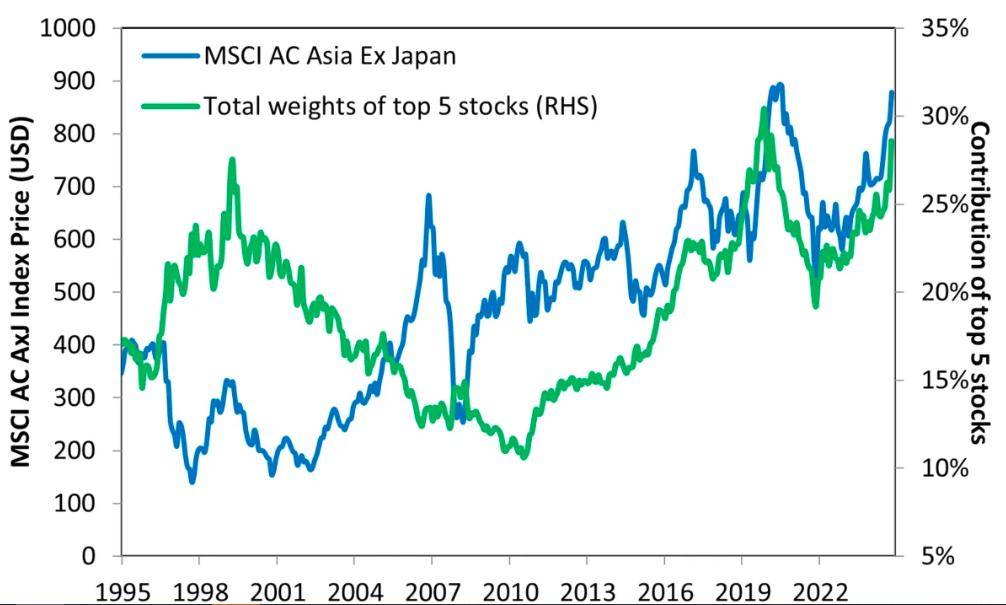
Some index providers have taken steps to help investors cope with these issues. FTSE Russell has capped the weights of some indexes, while MSCI and S&P Global have begun offering alternative versions of weight caps on key indexes.


